
ARTEMIS: Digital solutions for climate-resilient agriculture
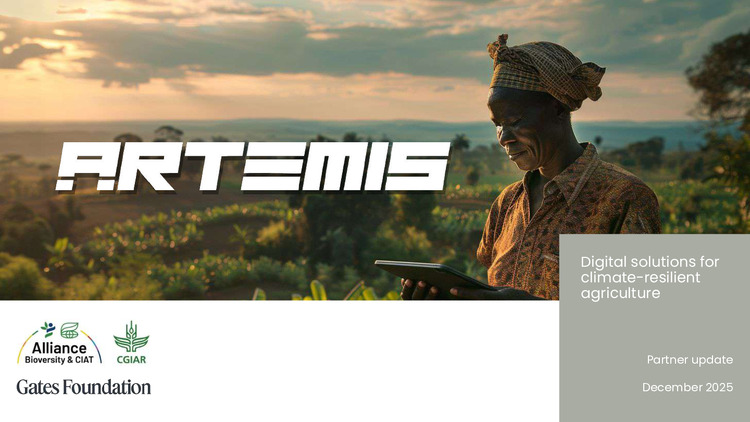
Accurate and scalable crop phenotyping remains a critical bottleneck in breeding programs, particularly in the Global South, where manual, paper-based methods are still widely used. These conventional approaches often lead to measurement errors, data loss, and delays in decision-making. This presentation introduces Artemis, a digital phenotyping system that integrates smartphone-based data collection (Ona), computer vision models, and standardized protocols to improve the efficiency and reliability of trait measurement under field conditions. The system replaces subjective human observation with machine-assisted, quantitative trait extraction, enabling consistent and high-throughput data collection. Model performance across multiple crops demonstrates strong predictive accuracy, with r² = 0.94 for common beans (≈100 images), r² = 0.85 for sorghum (≈500 images), and r² = 0.83 for cowpea (≈600 images). Field validation further shows substantial efficiency gains, with phenotyping time reduced to less than one minute per plot. Labor requirements decline by up to 54% for scientists and 40% for data collectors, while trial costs are reduced by approximately 17%, indicating improved cost-effectiveness in breeding operations. By improving data accuracy, reducing operational inefficiencies, and accelerating data-to-decision timelines, Artemis contributes to faster varietal development and increased genetic gain through more efficient data collection methods. These validation results highlight the potential of AI-driven, field-deployable phenotyping tools to transform breeding systems and support climate-resilient agriculture at scale.