
Agroecology+ Solutions implemented in three districts of the Omo-Gibe Living Landscape, Ethiopia
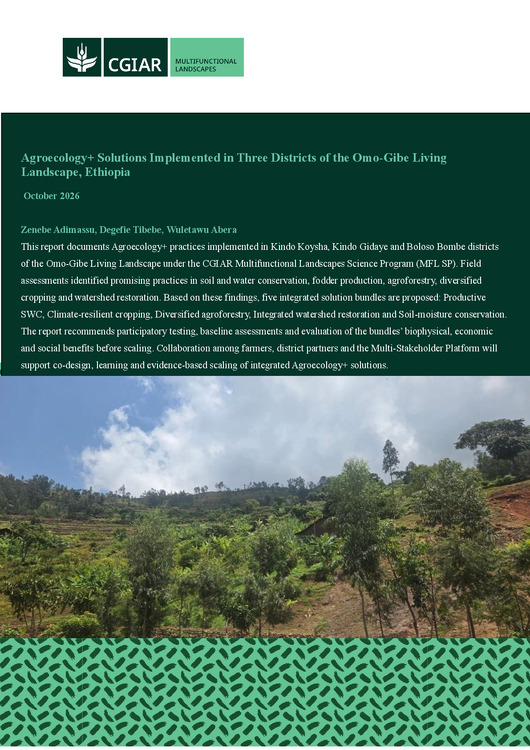
This report documents existing Agroecology+ practices observed during field assessments in Kindo Koysha, Kindo Gidaye and Boloso Bombe districts of the Omo-Gibe Living Landscape, Ethiopia, under the CGIAR Multifunctional Landscapes Science Program (MFL SP). The purpose was to identify locally implemented solutions, examine their potential complementarities and propose integrated bundles for participatory testing and possible scaling. The assessment used field observations, discussions with farmers and local stakeholders, and visits to community production sites, farms and watershed interventions. It is a qualitative assessment rather than an impact evaluation.
The field documentation identifies six localities across five main field stops. In Zebeto, a community site of approximately 3,100 m² multiplies Bana and Elephant grasses, with the report recording 1,517 households planting grasses in backyards. Mugisa/Medine demonstrates grasses on conservation structures, agroforestry and mixed cropping, with 2,520 farmers reported as involved. Banto Watershed, associated with RLLP investments, covers approximately 1,199.04 ha and includes soil bunds, stone faced bunds and trenches. In Ferewocha and Ajaro, farmers maintain local maize varieties, maize pigeon pea and maize–cowpea systems, mulching, ginger production and diversified home gardens. Mudine features tied ridges, mulch and Fanya Juu terraces for soil-moisture management. Reported counts require confirmation against implementing partner records.
Four cross-cutting opportunities emerge: making soil and water conservation more productive through vegetation and fodder; improving diversified cereal–legume systems; strengthening agroforestry and home gardens; and using community multiplication and farmer learning networks for adaptation and dissemination. The report proposes five preliminary bundles, retaining their original names: Bundle 1 – Productive SWC; Bundle 2 – Climate-resilient cropping; Bundle 3 – Diversified agroforestry; Bundle 4 – Integrated watershed restoration; and Bundle 5 –Soil-moisture conservation. These are options for codesign, not proven or fixed packages.
The main recommendation is to validate and georeference the inventory, establish representative farmer managed learning sites, collect consistent baselines, compare integrated bundles against current practice and document biophysical, economic and social trade-offs. District partners, existing RLLP
arrangements and the Omo-Gibe Living Landscape Multi-Stakeholder Platform can coordinate this process. MFL SP's role is principally facilitation, capacity strengthening, knowledge exchange and evidence generation; the observed interventions should not all be attributed to direct MFL SP implementation.
Overall, the field assessment indicates a useful foundation for moving from separate interventions toward context-specific, multifunctional production and restoration systems. Evidence from participatory testing will be needed before making claims about effectiveness or promoting landscape wide scaling.