
Agroecological practices improve productivity, soil carbon and derived-income outcomes of maize and bean systems in nutrient-deficient sandy soils of Makueni, Kenya
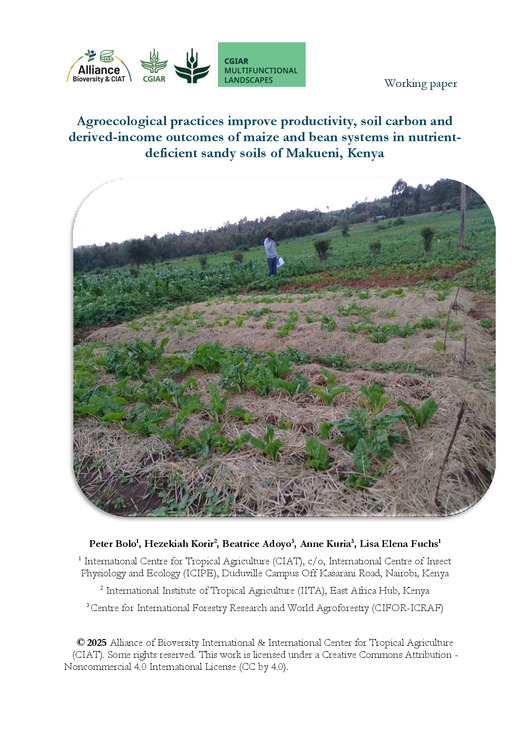
Agroecology is highlighted as a sustainable approach with the potential to support food system transformation in both low and middle-income countries. Its potential to improve soil and crop productivity is unmatched. Implementation of innovative agroecology practices is key in promoting soil quality and health, improving agrobiodiversity and enhancing crop productivity. We assessed the influences of select agroecology practices on maize and bean crop performance in nutrient deficient sandy soils in Makueni County, Kenya. The study was conducted on 34 resource-constrained smallholder farms during the short rains season of the year 2023. The innovative agroecology practices tested involved; i) use of biopesticides (IPM); ii) terracing, and iii) use of organic inputs (manure). The three agroecology practices geared towards pest (IPM), water (terraces) and soil (manure) management. The results show that agroecological practices involving combined use of biopesticides and organic inputs increased maize and bean yields relative to the rest of the practices. Across the three agroecology practices implemented, maize yields increased by at least 40 kilograms. Relative to control plots, maize yields increased by 109, 78 and 40 kilograms per acre respectively under terraces, manure and IPM practices, respectively. This was consistent to monetary gains averaging USD$ 50.26, 36.14 and 18.28 per acre in one season under terraces, manure and IPM, respectively. Similarly, bean yields increased by 20.7, 33.3 and 19.8 kilograms per acre per season, respectively under IPM, Manure and terraces. These were equivalent to monetary gains of USD$ 25.48, 40.98 and 24.37, respectively under IPM, Manure and terraces. The soils were slightly acidic to neutral (mean pH 6.51) and generally low in fertility, with low soil organic carbon (0.90%) and total nitrogen (0.09%). Average SOC stock (0–15 cm) was 19.12 t C ha⁻¹ (70.17 t CO₂-eq ha⁻¹), indicating modest carbon sequestration potential. Total nitrogen stock averaged 1.88 t N ha⁻¹, while annual mineralizable nitrogen was low (0.019 t N ha⁻¹ yr⁻¹), reflecting limited plant-available nitrogen. High phosphorus sorption capacity and elevated aluminium levels further constrained nutrient availability in these sandy soils. Overall, the findings provide preliminary evidence that employing context-specific agroecological practices can stimulate crop productivity and farmer income. The results support the promotion of integrated agroecological interventions—particularly organic inputs and biopesticides—as cost-effective strategies for improving productivity, soil function, and sustainability in semi-arid smallholder farming systems. Besides, the results also indicate that adoption of soil carbon enhancing practices, involving application of organic inputs, translate to better crop yields, income and offer additional ecological benefits.