
Advocacy training report - Malawi: Building Equitable Climate-Resilient African Bean & Insect Sectors (Brains)
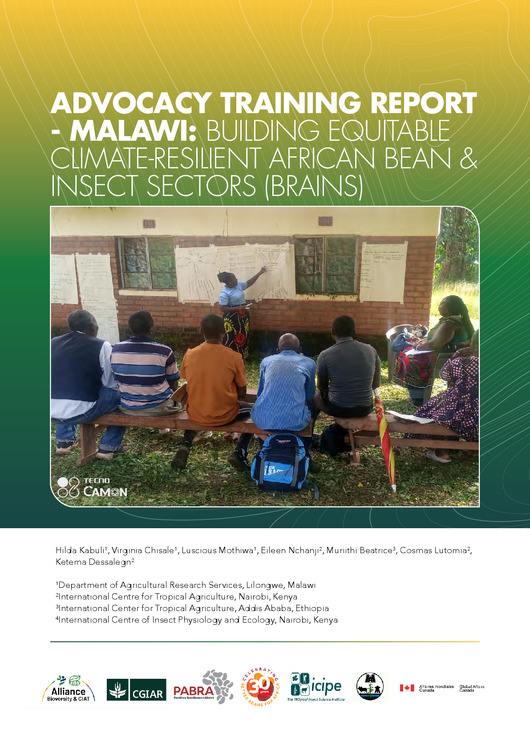
The Advocacy Training Report Malawi June 2026_NEB presents the outcomes of advocacy, negotiation, and
policy engagement training conducted under the Building Equitable Climate-Resilient African Bean & Insect
Sectors (BRAINS) project in Malawi. Implemented by the Department of Agricultural Research Services (DARS) in
partnership with PABRA, the Alliance of Bioversity International and CIAT, and the International Center of Insect
Physiology and Ecology (icipe), the project aims to strengthen climate resilience, promote gender equality, and
enhance the participation of women, youth, and other marginalized groups in agricultural transformation and
value chain development.
As part of this agenda, advocacy training workshops were conducted across Mwanza, Zomba, Rumphi, and
Nkhata Bay districts between April and June 2026. The training sought to empower women leaders, youth
leaders, traditional authorities, entrepreneurs, community champions, and other influential actors with the skills
needed to influence decisions, shape policies, and advocate for inclusive and equitable development within their
communities.
The overall objective was to strengthen participants’ advocacy, negotiation, and policy engagement capacities
to influence decision-making processes and address barriers that limit the participation and benefits of women,
youth, and persons with disabilities. Specifically, the training aimed to enhance understanding of gender
equality, equip participants with practical advocacy and negotiation skills, and strengthen their ability to identify
challenges, develop evidence-based advocacy strategies, and promote positive social change.
The training adopted participatory and learner-centred methodologies, including experiential learning, role
plays, visual tools, group discussions, stakeholder analysis exercises, and advocacy planning sessions. A total
of 39 participants were trained, comprising 25 women and 14 men, of whom 19 were youth, ensuring strong
representation of women and young people as change agents within their communities. Training was delivered
in local languages to maximise participation and comprehension.
Key training modules focused on advocacy and inclusive governance, gender equality and gender transformation,
root cause analysis, stakeholder mapping, SMART advocacy planning, interest-based negotiation, and effective
communication and storytelling. Participants learned how to identify and analyse systemic barriers affecting
women, youth, and vulnerable groups, develop actionable advocacy objectives, map influential stakeholders,
negotiate effectively with decision-makers, and design persuasive evidence-based messages. The training
emphasised addressing underlying causes of exclusion rather than symptoms and encouraged participants to
engage strategically with community leaders, institutions, and policymakers.
A significant outcome of the training was increased participants’ confidence to engage in advocacy and
community leadership. Post-training evaluation results showed that 95% of participants agreed that the training
addressed real community problems, while 100% felt safe expressing themselves during the training. Confidence
levels were particularly high, with 100% of participants reporting confidence in negotiating with leaders and
opponents, 97.5% in public speaking, 87.5% in stakeholder power analysis, and 82.5% in developing SMART
advocacy plans.
Participants committed to translating their learning into action by training others, organising community meetings,
speaking at public gatherings, engaging traditional leaders, and advocating for more equitable social norms.
Key advocacy messages emerging from the training focused on promoting equal roles and responsibilities, fair
resource sharing, inclusion of women, youth, and persons with disabilities, women’s rights, prevention of gender
based violence, and challenging harmful cultural practices. These commitments demonstrate participants’
readiness to facilitate community-level change and strengthen inclusive decision-making processes.
Overall, the advocacy training contributed significantly to the BRAINS project’s gender-transformative objectives
by developing a cadre of local champions equipped to influence policies, challenge discriminatory norms, and
foster more inclusive governance processes. Through strengthened advocacy, negotiation, and leadership
BUILDING EQUITABLE CLIMATE-RESILIENT AFRICAN BEAN & INSECT SECTORS
3
capacities, the training has laid a foundation for greater social inclusion, gender equality, and community-driven
agricultural transformation in Malawi