
Advocacy training report – Ghana. Building Gender Equitable Resilience for Adaptation to Climate Across Bean Crop and Insect Corridors (BRAINS)
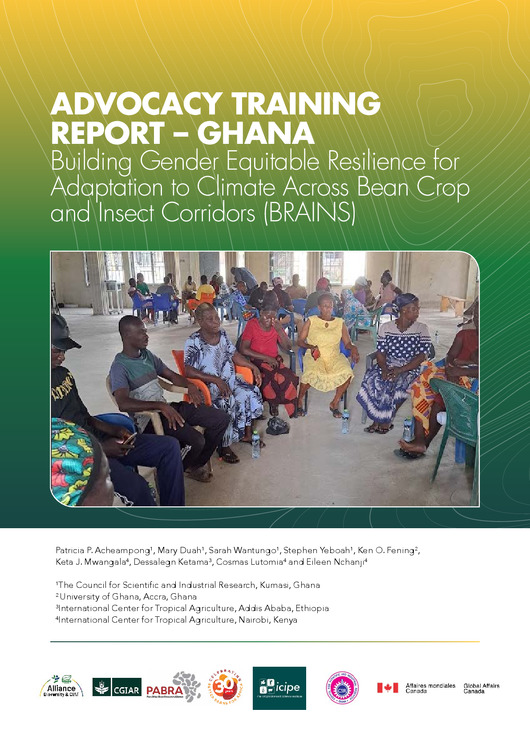
The "Building Gender Equitable Resilience for Adaptation to Climate Across Bean Crop and Insect Corridors (BRAINS)" project convened an intensive advocacy training in the Offinso South district of the Ashanti region in Ghana. The primary objective was to empower women, youth, and men in agrifood systems—including local and traditional leaders, cooperative heads, and entrepreneurs—to actively influence decision-making and drive inclusive governance. The training was designed to equip these actors with professional skills in strategic advocacy, stakeholder power mapping, interest-based negotiation, and long-term coalition-building. The session engaged a diverse group of 58 stakeholders, comprising 17 women, 6 young women, 17 men, and 8 young men. Grounded in the philosophy of positioning community members as active agents of systemic change, the training utilized a highly participatory methodology. Facilitators employed experiential learning, literacy-neutral visual tools, group dialogue, and practical role-playing exercises to bridge the gap between lived experiences and actionable policy influence.
Participants explored advocacy as a powerful instrument to dismantle the cultural, structural, and institutional imbalances that frequently exclude women and youth from leadership. The curriculum emphasized three strategic pillars: targeting the specific decision-makers who hold power, addressing root causes rather than superficial symptoms, and combining rigorous evidence with compelling lived experiences to persuade authorities. To transition from stating complaints to strategically demanding solutions, participants worked in commodity-specific groups (cashew, pawpaw, and cowpea) to visually map their core agricultural challenges. They utilized the "Issue Tree" tool to systematically link underlying causes (the roots) to their direct consequences (the branches). learned to identify and categorize local actors connected to their priority issues. They mapped individuals and institutions with the power to influence change, as well as potential allies and opponents.
Through collaborative planning, the agricultural groups identified specific systemic issues to champion in their post-training advocacy efforts: combating the impacts of climate change, which are exacerbated by practices like bush burning and deforestation, leading to increased irrigation costs and reduced yields. They identified buyers and water suppliers as their most critical stakeholders. Addressing limited market access and inadequate processing facilities, which contribute to post-harvest losses, unplanned debt, and community poverty. They targeted government ministers, local chiefs, and market queens as primary figures for engagement. Address limited access to farmland driven by declining soil fertility, sand mining, and land conversion. They strategically mapped landowners and capital providers as key stakeholders to negotiate with.
Ultimately, the workshop ensured that participants were prepared to take full ownership of their campaigns, track policy outcomes and impacts, and guaranteed that proposed solutions are implemented correctly and actively support community resilience.