
Advocacy Training Report - Ethiopia: Building Gender Equitable Resilience for Adaptation to Climate Across Bean Crop and Insect Corridors (BRAINS)
Agricultural development increasingly depends not only on technological innovation but also on the ability of
communities to influence decisions that affect their livelihoods. While farmers frequently identify challenges
related to production, markets, infrastructure, finance and climate change, these concerns often remain unresolved
because communities lack the strategic skills required to engage decision-makers, negotiate effectively and
advocate for institutional change. Recognizing this gap, the BRAINS project integrates strategic advocacy as
a complementary component of leadership development to strengthen inclusive governance and improve
community influence over agricultural development processes.
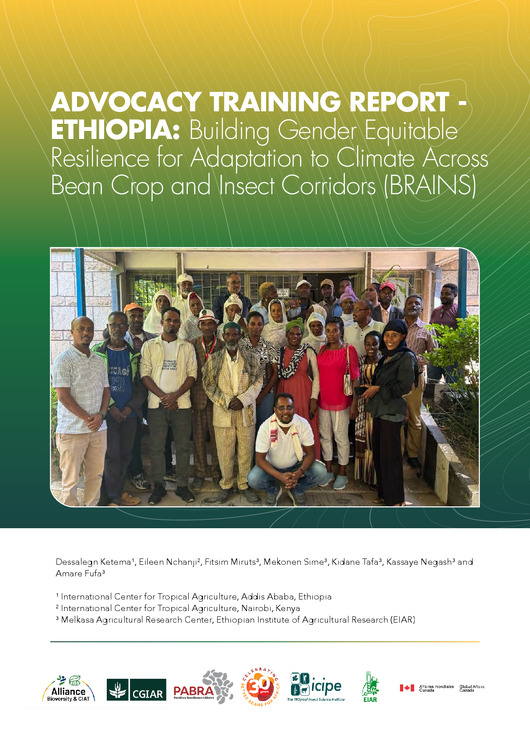
On 3 July 2026, the Alliance of Bioversity International and CIAT, in collaboration with Melkasa Agricultural
Research Center (MARC), conducted a one-day Strategic Advocacy Training under the BRAINS Project. The
training followed immediately after the Leadership Training and brought together the same 29 participants,
comprising 15 women (51.7%) and 14 men (48.3%), representing farmers, agricultural experts, entrepreneurs,
local government institutions and community organizations. Approximately nine researchers and administrative
staff from MARC also participated in facilitating discussions and supporting practical group exercises.
Unlike conventional advocacy workshops that focus primarily on communication techniques, this training
emphasized strategic influence, evidence-based decision-making and systems thinking. Participants learned
that advocacy extends beyond expressing dissatisfaction; it is a deliberate and organized process aimed at
influencing policies, institutions and resource allocation through constructive engagement with decision-makers.
The programme adopted a highly participatory learning approach combining issue-tree analysis, stakeholder
mapping, SMART advocacy planning, negotiation simulations, policy engagement exercises, elevator pitch
development and group presentations. Participants worked collaboratively to analyse real agricultural and
institutional challenges from their own communities, identify underlying structural causes, map influential
stakeholders and design practical advocacy strategies capable of generating sustainable change.
One of the most significant achievements of the training was participants’ transition from focusing on symptoms
toward analysing systemic causes. Through Issue Tree exercises, participants recognized that many agricultural
challenges-including limited women’s participation, inadequate extension services, weak market access and
climate vulnerability are rooted in institutional arrangements, governance systems and unequal power relations
rather than isolated technical constraints.
The stakeholder mapping exercises further strengthened participants’ ability to distinguish between allies,
opponents, decision-makers and neutral actors. Participants learned that successful advocacy depends not only
on the strength of an argument but also on understanding who holds influence, how decisions are made and
which engagement strategies are most appropriate for different stakeholders.
Another major outcome was participants’ increased confidence in translating broad concerns into SMART
advocacy objectives. Rather than presenting generalized demands, participants developed clear, measurable
and time-bound advocacy goals supported by evidence and practical implementation strategies.
The negotiation simulations and elevator pitch exercises provided valuable opportunities for participants to
practise communicating persuasively while balancing evidence with personal experience. Many participants
reported increased confidence in engaging local authorities, cooperative leaders and development partners
after participating in these practical exercises.
The training concluded with individual and group advocacy commitments through which participants pledged
to initiate specific advocacy actions within their communities over the following three months. Participants further
committed themselves to disseminating the knowledge acquired during the training to at least 25 additional
community members, thereby extending the reach of the BRAINS project beyond the immediate participants.
BUILDING EQUITABLE CLIMATE-RESILIENT AFRICAN BEAN & INSECT SECTORS
3
Overall, the Strategic Advocacy Training successfully strengthened participants’ analytical thinking, communication
skills, stakeholder engagement capacities and confidence to influence agricultural development processes. The
report concludes that continued mentoring, institutional collaboration and follow-up support will be essential for
translating these advocacy competencies into measurable improvements in inclusive governance, agricultural
resilience and gender-equitable development